Why FG studs keep tearing on Dhaka turf
Almost every ground in this city is artificial. Firm-ground studs are built for soil that gives way. What happens when they meet a carpet that does not.
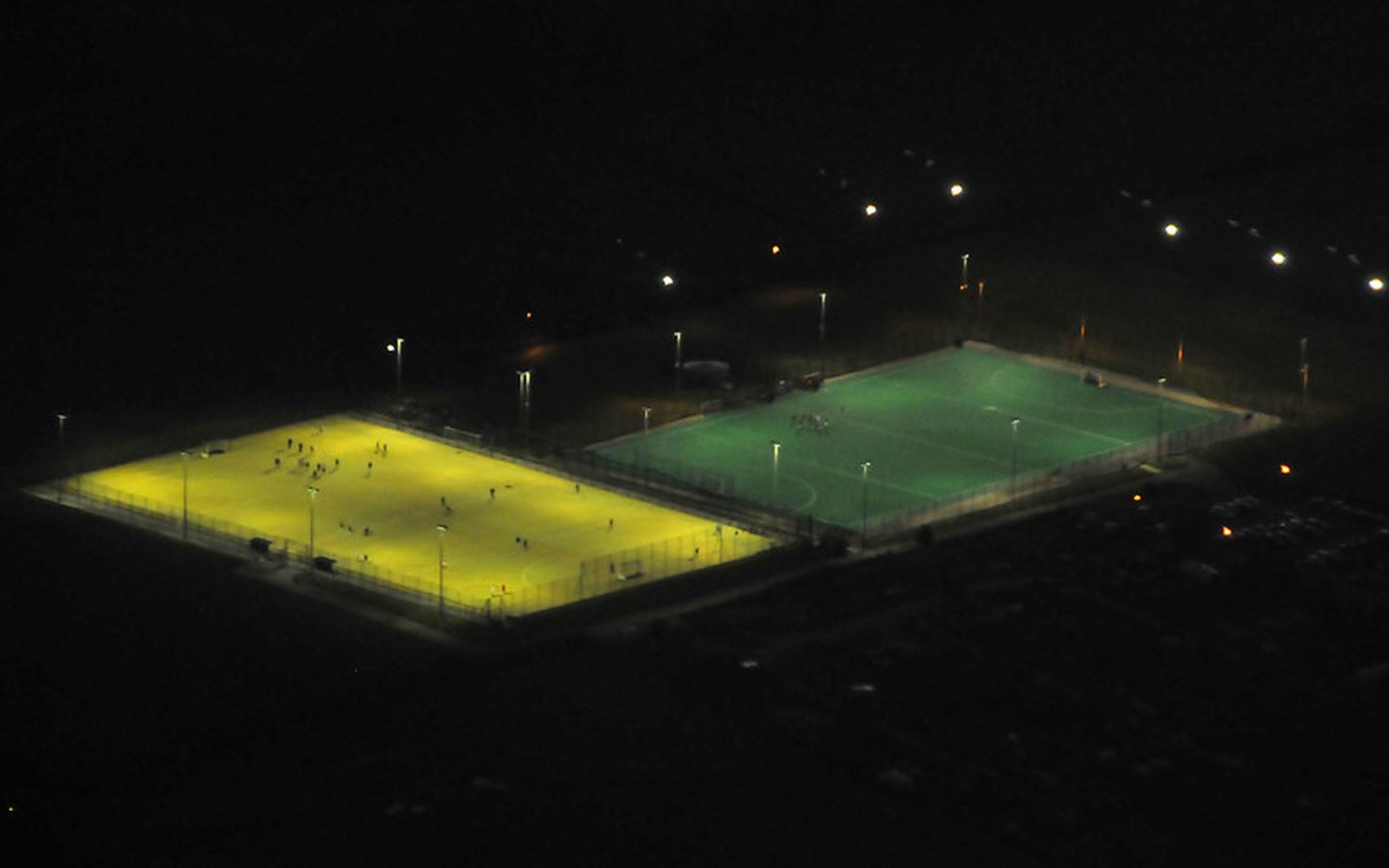
THE GROUND YOU ACTUALLY PLAY ON
Count the places you played last month. A rooftop cage in Banani. A five-a-side arena off Mirpur Road. A school field on a Friday morning. In Dhaka that count comes out artificial almost every time. Playable natural grass exists at a few club and institutional fields, but you are not on it weekly, and from June to September it is mud in any case. The ground that is free at 9pm on a Tuesday is turf.
WHAT THE LETTERS ON THE BOX MEAN
- FG, firm ground
- Ten to thirteen studs, 10 to 13 mm, on a stiff plate. Built to sink into natural grass with soil under it.
- SG, soft ground
- Six replaceable metal studs for wet grass. Banned at every turf ground in the city, correctly.
- AG, artificial grass
- Fifteen to twenty-two shorter studs, hollow through the middle, on a softer plate. Built for 3G pile with rubber infill.
- TF, turf
- Dozens of small rubber nubs across the whole outsole. For short-pile carpet, sand-filled surfaces and baked-hard ground.
- IN or IC, indoor
- Flat gum rubber, non-marking. Wood and painted concrete only. On damp turf it is a skate.
WHAT FG DOES TO THE BOOT
An FG stud expects to lose. On grass it sinks 8 to 10 mm and the soil takes the load. A 3G surface is 40 to 60 mm of plastic fibre standing in rubber crumb, laid over a shock pad or straight over concrete. The stud gets about 4 mm in and stops. Everything after that, your weight and your acceleration, is carried at the joint where the stud meets the plate.
Three failures follow, usually in this order. A stud shears at the base, most often an outer forefoot stud on your pivot side. Then the plate cracks across the flex line under the ball of the foot. Last, the outsole begins lifting off the upper at the toe, because glue does not hold on a plate that flexes wrong. On a twice-a-week schedule we see the first sheared stud somewhere around month three.
The plate is not bending where it was designed to bend, so it bends where it can.
WHAT FG DOES TO THE PLAYER
The stud that will not sink also will not release. Turn hard on 3G in FG boots and the foot stays planted while the rest of you rotates. That load goes into the medial knee and the ankle. It is worse on new carpet, in the dry, at pace, which describes most weeknight five-a-side in this city.
The quieter problem is pressure. Thirteen studs on a surface that does not yield push back through a stiff plate into the metatarsal heads. You feel it as a hot spot under the ball of the foot after forty minutes, and if you keep going, as bruising that takes weeks to settle. Players blame the insole. It is the stud pattern.
READING A GROUND BEFORE YOU COMMIT
- Push two fingers into the pile at the sideline. Fibre 40 to 60 mm deep with black rubber crumb between it is 3G. That is an AG ground.
- Short stiff pile with sand in it, or no infill at all, over a hard base, is old-style astro. That is TF.
- Rooftop cage: assume thin carpet over concrete until proven otherwise. Stamp near the fence. If it rings, it is concrete. TF, plus a cushioned insole.
- Drop a ball from head height. A knee-high bounce means there is a shock pad under the carpet. Chest-high means there is not.
- Natural grass in Dhaka in April is as hard as the road beside it. FG will not go into that either.
WHY THE WALL IS STILL MOSTLY FG
This is stock, not conspiracy. FG is the volume line. Brands build the pro colourway in FG and SG first, because that is what is worn on television, and produce AG as a smaller run in fewer sizes, often only in the mid-tier model. Importers buy on cost per pair and on sell-through, and the FG box moves because the customer recognises the boot from a match. Grey stock arriving from markets where the local ground is grass adds to it. The result is a wall of firm-ground boots in a city with almost no firm ground.
We keep AG and TF deep and FG thin, and we will not sell you FG for a turf schedule. If you want the FG version of a boot for a specific grass fixture, we will order it in. We will also tell you the outsole warranty is void the moment it goes on a carpet. Every brand writes that into its terms and almost nobody reads it.
WHAT TO BUY, AND WHAT IT COSTS
FG works on grass and fails on turf. AG works on turf and copes on grass. Only one of those is a one-pair answer.
- TF, entry
- ৳2,900 to ৳4,500. Rubber nubs, no plate to crack. Right for rooftops and short pile.
- AG, mid
- ৳5,500 to ৳9,000. Hollow studs, softer plate. The default for a Dhaka turf schedule.
- AG, upper
- ৳9,500 to ৳16,000. Lighter plate, better upper. Buy it for fit, not for the weight number.
- Futsal, IN or IC
- ৳3,200 to ৳6,000. Only if you play on wood or painted court.
- Not worth buying
- FG under ৳4,000. The plate is the first thing to fail on a cheap firm-ground boot, and on turf it fails fast.
Nearly all of this sits below ৳15,000. Free delivery inside Dhaka starts at ৳3,000, which one pair plus a set of shin guards usually clears.
HOW LONG A TURF BOOT LASTS
Twice a week, ninety minutes, on 3G, from what comes back to our bench:
- TF: ten to fourteen months. At roughly a hundred sessions the forefoot nubs round off and the sole goes slick in the wet well before it looks worn.
- AG: twelve to eighteen months. Wear shows first on the studs at the inside forefoot, the ones you pivot on. A third off the original height means it is done.
- FG on turf: three to five months to a sheared stud or a cracked plate. That is the argument in one line.
Send a photo of the outsole of the pair you are replacing on WhatsApp. The wear pattern on an old outsole tells us more about the ground you play on than a description will. If a stud shears inside three months on a boot we sold you for turf, that one is ours.
Written by our football desk. Updated September 2026.